

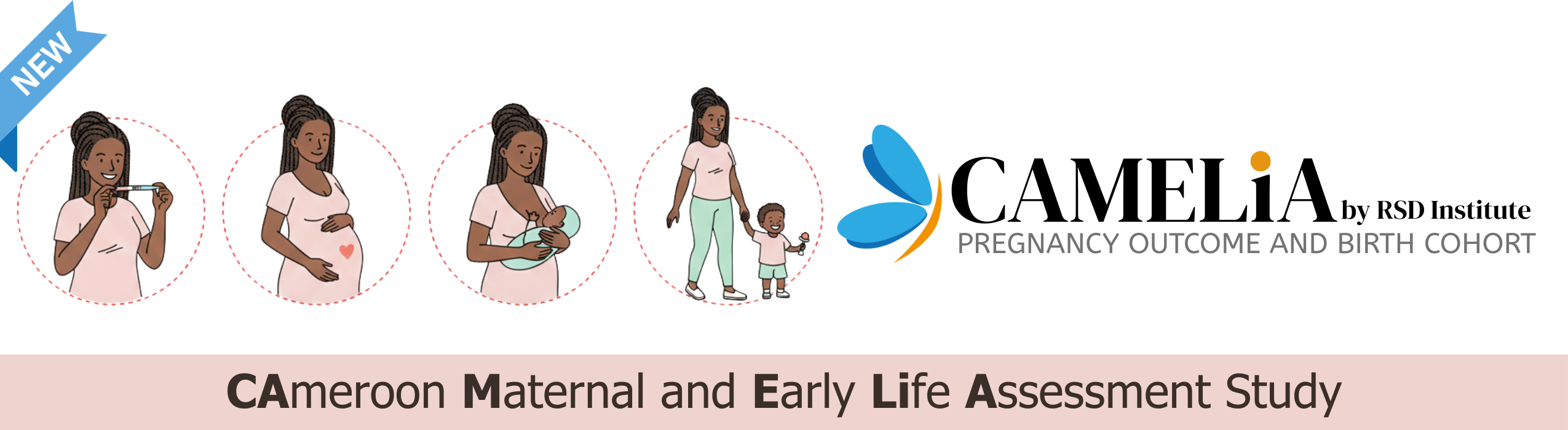
The Cameroon Maternal & Early Life Assessment Study (CAMELIA) is a prospective, quasi-experimental cohort study conducted in Yaoundé, Cameroon. Rooted in the Developmental Origins of Health and Disease (DOHaD) framework, the study addresses the critical lack of data in low- and middle-income countries regarding the impact of the intrauterine environment on long-term offspring health. By recruiting 1,200 pregnant women, the project investigates the prevalence and risk factors of gestational diabetes mellitus (GDM), alongside the effects of environmental exposures such as pesticides and alcohol. The study integrates a nutritional education intervention at one of its two urban sites to evaluate its effectiveness in improving maternal-fetal outcomes. Through four comprehensive assessments spanning from early pregnancy to the postpartum period, CAMELIA collects extensive clinical, dietary, and biological data. A significant long-term goal is the establishment of a robust biobank and the study of epigenetic markers, providing a unique resource for future research into the transgenerational prevention of non-communicable diseases and informing evidence-based public health policies in Africa.
Project Details
Duration: 2025 – 2028
Target Group: Pregnant women in Cameroon
Category: NCD Prevention & Management | Infant Health
ISRCTN registry : ISRCTN13961105 (read more)
Cameroon’s rapid urbanization is transforming lifestyles and fueling a rise in non-communicable diseases. However, critical data is missing: we lack clear evidence on how common gestational diabetes is and to what degree pregnant women are exposed to environmental toxins like pesticides and alcohol. Science tells us these early exposures can permanently influence a child’s long-term health. Furthermore, while better nutrition is essential, it remains untested which interventions actually work within the real-world context of Cameroonian cities. The CAMELIA study was created to close these gaps, generating the robust evidence needed to inform effective maternal and child health strategies in urban Africa.
- Ascertain GDM Data:Determine the prevalence and specific risk factors for gestational diabetes mellitus at early pregnancy, the third trimester, and the postpartum stage.
- Assess Environmental Exposure: Quantify contemporary maternal exposure levels to pesticides, alcohol, and tobacco and evaluate their impact on perinatal outcomes.
- Evaluate Intervention Impact: Assess the effectiveness of a structured nutritional education program on maternal metabolic health and neonatal outcomes.
- Investigate Epigenetics: Study potential epigenetic alterations (such as DNA methylation) induced by environmental and lifestyle exposures during pregnancy.
- Establish a Bioresource: Create a prospective pregnancy cohort and an associated biobank to facilitate future transgenerational health research.
The CAMELIA project is a prospective, quasi-experimental cohort study designed to evaluate maternal and neonatal health outcomes. To ensure scientific rigor, the study follows a 2:1 allocation ratio with a target sample size of 1,550 pregnant women.
Level 1: Site & Administrative Management
Our administrative framework ensures that all research is conducted within a controlled, ethical, and highly standardized environment. The project is strategically anchored in two key health districts in Yaoundé, utilizing MonSeigneur Jean Zoa Hospital as the Intervention Site and Biyem-Assi District Hospital as the Control Site. All activities strictly adhere to full ethical approval granted by the National Ethics Committee (Ref no. 2025/04/1790/CE/CNERSH/SP). To guarantee consistency and quality, every member of the research team, including midwives, doctors, and research assistants, undergoes intensive training on specialized Standard Operating Procedures (SOPs) and clinical ethics.
Level 2: Clinical Framework & Participant Journey
We follow a longitudinal approach, tracking participants from their first trimester through the postpartum period. Recruitment and enrollment (Visit 1) occur during the first antenatal care visit (at or before 22 weeks of gestation), utilizing the REDCap system for secure baseline data collection and initial Gestational Diabetes Mellitus (GDM) screening. During the second trimester (Visit 2, 24–32 weeks), participants return for comprehensive clinical assessments, including a secondary GDM screening; those in the intervention group receive targeted nutritional support. The delivery and neonatal assessment (Visit 3) focuses on capturing key labor outcomes, such as Apgar scores and birth weight, and includes the critical collection of umbilical cord blood. Finally, the postpartum review (Visit 4) at 42 days postpartum completes the cycle with smart band data retrieval and dedicated follow-up for any mother diagnosed with GDM.
Level 3: Laboratory Research & Biobank Management
Our laboratory protocols are designed to facilitate high-precision biomarker analysis and ensure long-term data preservation for future science. We conduct systematic collection of maternal blood and urine samples at scheduled intervals throughout the pregnancy. These samples are immediately transported via a secured cold chain to the Biotechnology Centre of Nkolbisson for advanced processing, including centrifugation and aliquoting. Our biomarker analysis focuses specifically on pesticide and alcohol metabolites, key hormonal biomarkers, and DNA extraction for genetic profiling. For enduring scientific value, all samples are archived in a dedicated biobank at -80°C using a unique barcoding system, creating a permanent resource for future epigenetic and molecular research.
By seamlessly integrating rigorous administrative oversight, detailed clinical monitoring, and precise laboratory science, the CAMELIA project delivers a comprehensive and multidimensional perspective on maternal health. This structured, multi-level approach is fundamental to producing robust, reliable, and actionable findings on gestational diabetes and prenatal environmental exposures.
Our work generates critical, multi-dimensional data to address key health challenges:
-
For Policy: Providing evidence to shape national guidelines on gestational diabetes (GDM) screening and environmental health.
-
For Science: Establishing a permanent biobank to support cutting-edge molecular and epigenetic research in Cameroon.
-
Clinical Health: Measuring GDM prevalence, blood pressure, BMI, and detailed body composition (e.g., muscle mass, visceral fat).
-
Environmental Exposure: Quantifying concentrations of pesticide and alcohol metabolites in both maternal and newborn cord blood.
-
Newborn Outcomes: Recording birth weight, length, head circumference, and Apgar scores to assess initial neonatal health.
-
Lifestyle Factors: Tracking changes in dietary intake (via 24-hour recall) and daily physical activity (via step counts).
Self-funding (RSD Institute)
Projet encore en cours d’implémentation.
The project involves a broad consortium of partners:
- MonSeigneur Jean Zoa Hospital & Biyem-Assi District Hospital: Clinical recruitment sites.
- Biotechnology Centre of Nkolbisson: Laboratory processing and biobank storage facility.